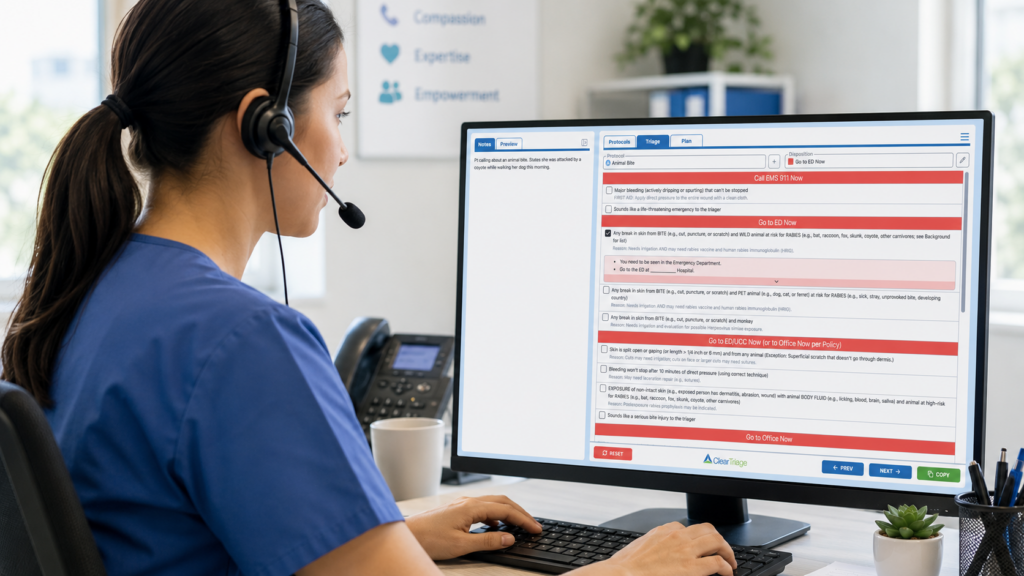
ClearTriage helps clinical teams use the standardized Schmitt-Thompson telephone triage protocols while giving organizations flexibility in how nurse telephone triage documentation appears in the medical record.
Because organizations vary in how they decide to document triage calls, ClearTriage includes account-level documentation settings that let your team choose the note format that best meets its communication and risk management needs. These settings affect how the triage assessment and care advice appear in the call note.
There is no single right or wrong way to document a triage call. What matters most is that the triage documentation is clear, consistent, and aligned with your organization’s standards. These documentation options do not change how patients are triaged nor how the Schmitt-Thompson protocols are used. They only affect how the triage assessment and care advice are documented in the medical record.
Standardizing Nurse Telephone Triage Documentation
Organizations often come to ClearTriage with existing documentation habits. Some prefer to continue documenting calls in a way that closely matches their previous process. Others use the transition to ClearTriage as an opportunity to review their triage documentation style and choose a new approach, often with input from both nursing staff and providers.
Because consistency is so important, these documentation choices are account-level settings. That means the selected options apply to everyone using the account, helping ensure call notes are formatted consistently across your organization.
Triage Documentation Options
ClearTriage offers two main options for documenting triage questions in the call note:
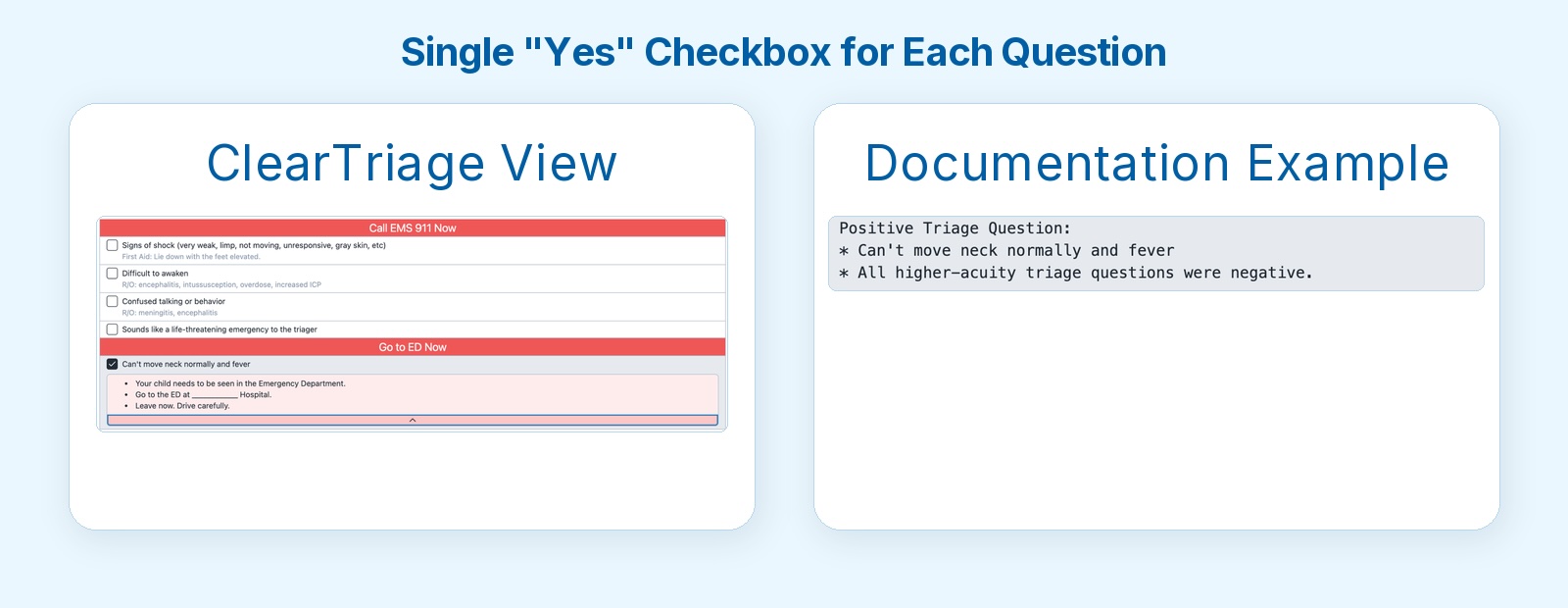
Option 1: Single “Yes” Checkbox for Each Question
With this option, nurses document only the positive finding by selecting a single “Yes” checkbox for the applicable triage question. Pertinent negatives can still be documented manually in the free-text field at the top of the screen if desired.
This approach creates a shorter call note and may feel familiar to organizations that prefer documenting only the findings that directly support the selected disposition.
This option is often preferred by organizations that want to:
- Keep documentation concise
- Avoid lengthy lists of negative responses
- Make the chart easier to scan
- Reduce the time nurses spend documenting during the call
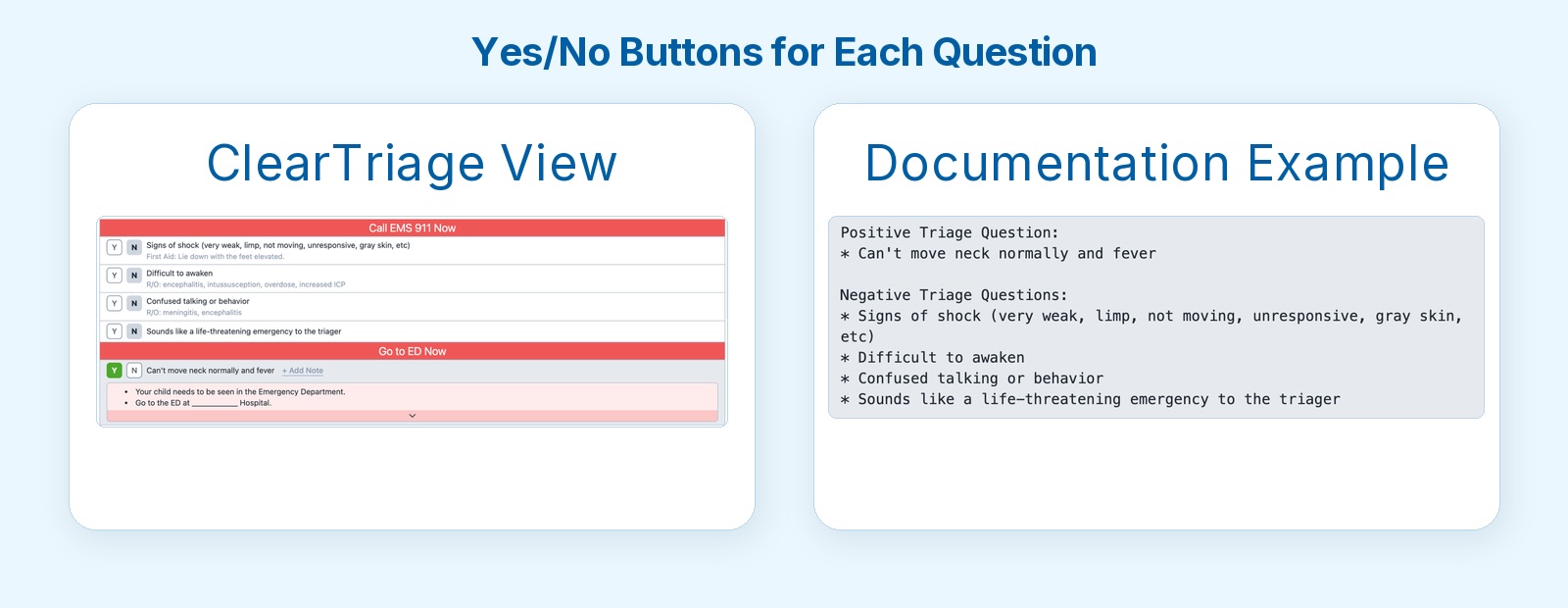
Option 2: Yes/No Buttons for Each Question
With this option, nurses document both positive and negative findings by selecting “Yes” or “No” for each triage question until they reach the first positive triage question.
This creates a more detailed call note and provides a clear record of the questions that were assessed during the triage process.
This option is often preferred by organizations that want to:
- Document findings that were both ruled-in and ruled-out
- Give providers more context about the patient’s symptoms
- Create a more complete record of the nurse’s decision-making process
- Show which higher-acuity questions were considered before selecting the disposition
Care Advice Documentation Options
ClearTriage also offers several options for documenting the care advice provided to the caller.
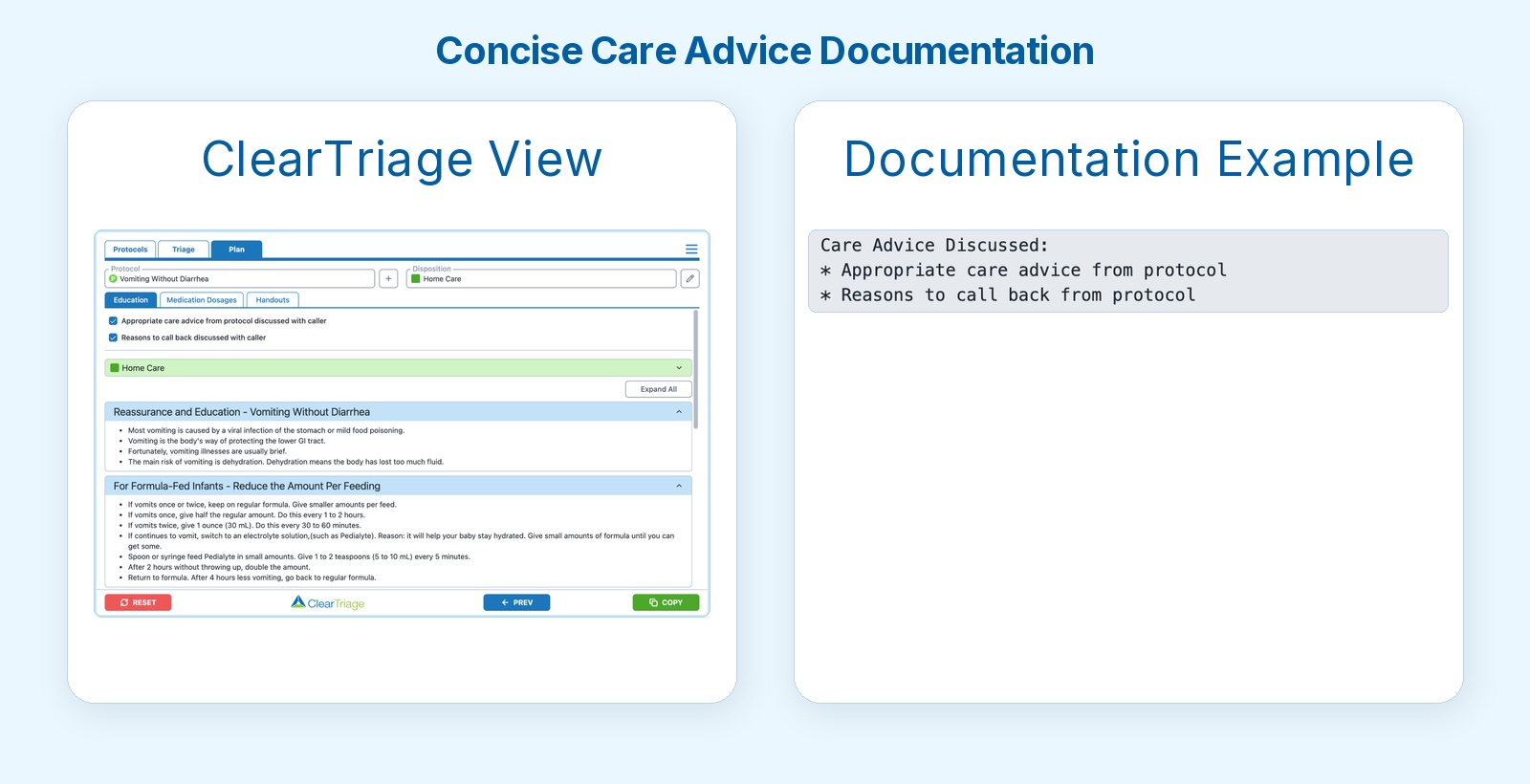
Option 1: Concise Care Advice Documentation
The concise option is designed for the fastest calls and the simplest care advice documentation.
With this option, the nurse can document that care advice was provided without spending additional time selecting specific care advice elements.
This option may be a good fit for organizations that want:
- Shorter call notes
- Faster documentation
- A simpler care advice workflow
- Less time spent marking individual care advice items
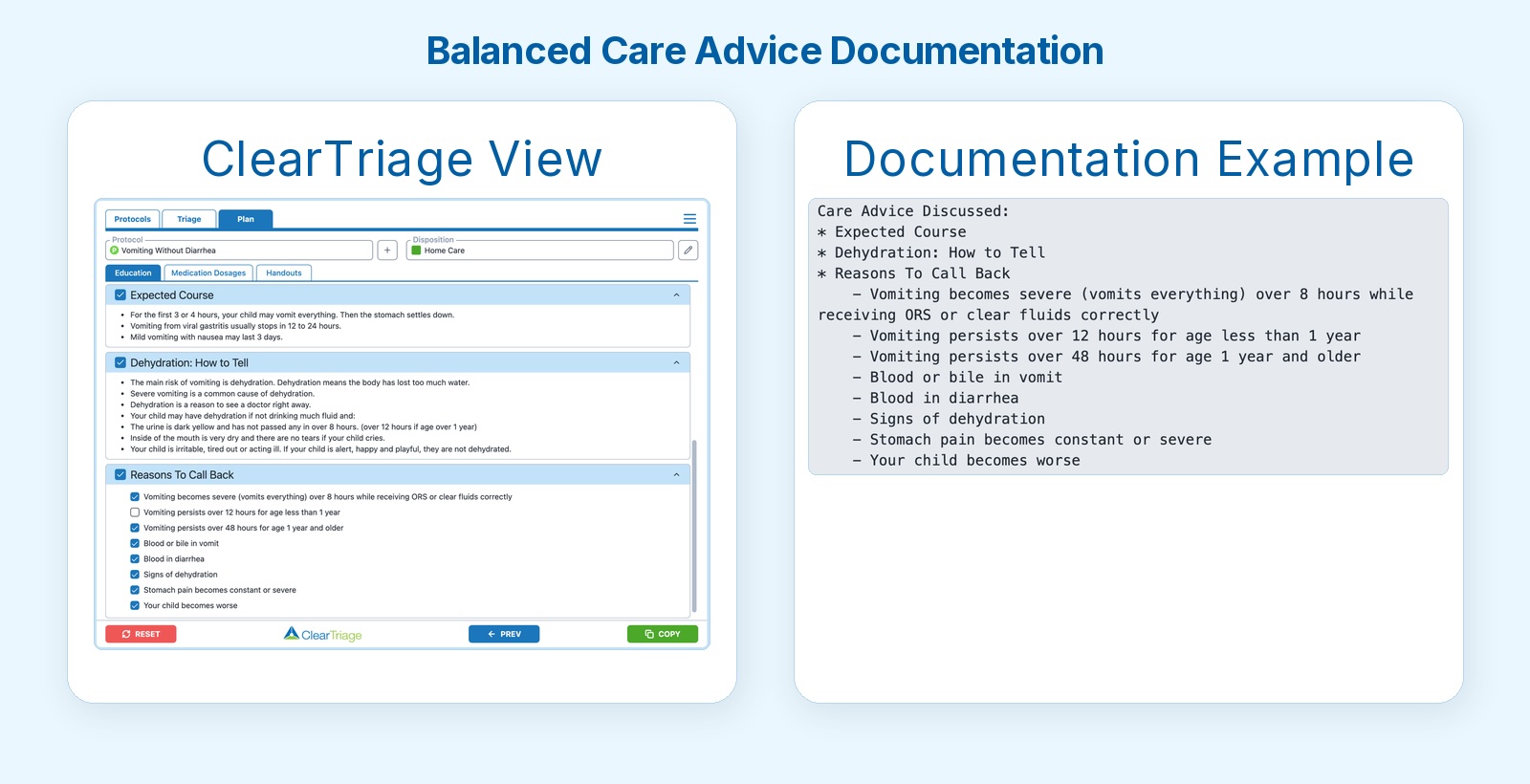
Option 2: Balanced Care Advice Documentation
The balanced option provides some additional detail while still keeping calls efficient.
With this setting, the nurse selects the general topics of care advice that were discussed, rather than selecting every individual care advice element. This gives the chart more structure and detail without adding as much documentation time as the detailed option.
The nurse can still select specific elements in the Reasons to Call Back section.
This option may be a good fit for organizations that want:
- More detail than the concise option
- A faster workflow than fully detailed documentation
- A general record of the care advice topics discussed
- A practical balance between speed and completeness
Option 3: Detailed Care Advice Documentation
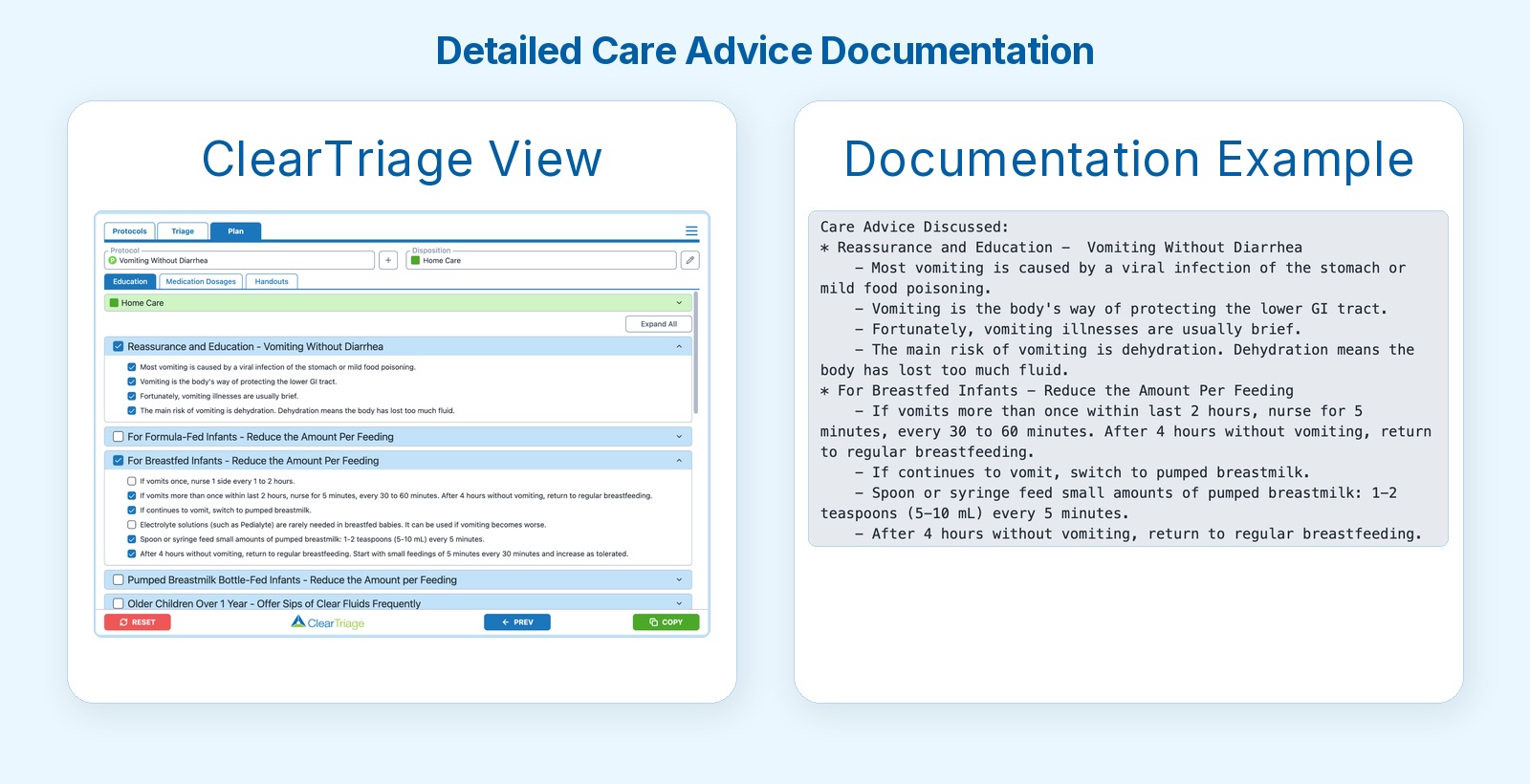
The detailed option allows nurses to document the specific care advice elements that were discussed during the call.
This creates a more complete care advice record, but it also requires more time because the nurse marks individual care advice items. Plus there is more text in the call note for the rest of the care team to review.
This option may be a good fit for organizations that want:
- More detailed care advice documentation
- A clearer record of specific instructions discussed
- More visibility into the education provided during the call
- A more comprehensive call note
How to Change Documentation Settings in ClearTriage
To change these settings, sign in to ClearTriage Admin and select Account Settings.
You can also review these short videos:
Which Telephone Triage Documentation Option Should You Choose?
Organizations generally take one of two approaches when documenting triage questions.
The first approach is to document only the first positive triage question. With this workflow, the nurse is expected to rule out the higher-acuity questions above the first positive question, either directly or indirectly, before selecting the appropriate disposition.
Supporters of this approach feel that documenting every negative response is unnecessary, adds time to the call, and can make the chart more difficult to read.
The second approach is to document both positive and negative triage questions. Supporters of this method feel that recording the questions the nurse ruled out creates a more complete call note, gives the provider additional context, and may offer a clearer record of the nurse’s decision-making process.
Neither approach is inherently right or wrong. The best choice depends on your organization’s documentation preferences, clinical workflow, and expectations for the call note.
Consistency and a Clear Process are Key
Whatever approach your organization chooses, consistency between calls and between nurses is important for clear communication with the care team and for reducing liability risk. It’s also important to have a standardized process stating that ClearTriage and the Schmitt-Thompson protocols are used on every symptom-based triage call, and stating that all higher acuity triage questions are ruled out before selecting the first positive triage question.
Note that if your organization is using the yes/no buttons, documenting negative responses for some questions but not others can create risk and confusion when the chart is reviewed later. For example, it may be unclear whether undocumented questions were ruled out, not asked, or simply not recorded.
For that reason, each organization should establish a clear documentation standard and apply it consistently across all triage nurses and call notes.
Ruling Out Questions Does Not Mean Asking Every Question Word-for-Word
Regardless of which documentation option your organization chooses, ruling out the questions above the first positive question does not mean the nurse must ask every question exactly as written.
Some questions may be ruled out during the initial intake. Others may be ruled out based on the patient’s age, medical history, or other information.
The triage nurse should use clinical judgment, experience, and the information already gathered from the caller to determine which questions need to be asked directly and which can be ruled out without asking.
Do Documentation Settings Change How Schmitt-Thompson Protocols Are Used?
No. Documentation settings only affect how the call note is formatted. They do not change the Schmitt-Thompson telephone triage protocols, the disposition for a call, or the clinical process and content used during the call.
Additional Resources
The following resources offer two different perspectives on telephone triage documentation and may be helpful as your organization evaluates its preferred approach.
- Barbara Hansen, “A Legal Perspective on Nurse Telephone Triage Documentation,” interview transcript
- Carol Rutenberg, “Documentation of the Telephone Triage Encounter,” video presentation
ClearTriage is a web-based decision support tool for telephone triage nurses and the leading provider of the Schmitt-Thompson telephone triage protocols. Start your 30-day free trial today!